

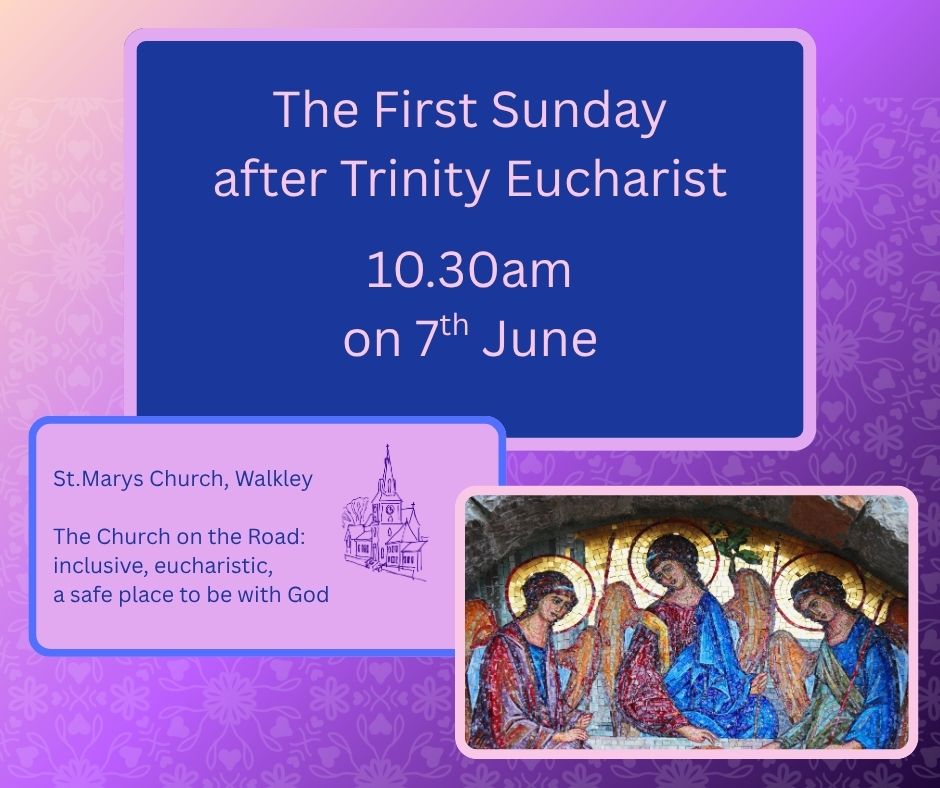
Watch this week's service on YouTube
Download the order of service here: 26 06 07 1st Sunday after Trinity
Read this week's Church News
The Readings
Romans 4.13-25
For the promise that he would inherit the world did not come to Abraham or to his descendants through the law but through the righteousness of faith. If it is the adherents of the law who are to be the heirs, faith is null and the promise is void. For the law brings wrath; but where there is no law, neither is there violation. For this reason it depends on faith, in order that the promise may rest on grace and be guaranteed to all his descendants, not only to the adherents of the law but also to those who share the faith of Abraham (for he is the father of all of us,
as it is written, “I have made you the father of many nations”) —in the presence of the God in whom he believed, who gives life to the dead and calls into existence the things that do not exist. Hoping against hope, he believed that he would become “the father of many nations,” according to what was said, “So numerous shall your descendants be.” He did not weaken in faith when he considered his own body, which was already as good as dead (for he was about a hundred years old), or when he considered the barrenness of Sarah’s womb. No distrust made him waver concerning the promise of God, but he grew strong in his faith as he gave glory to God, being fully convinced that God was able to do what he had promised. Therefore his faith “was reckoned to him as righteousness.”
Now the words, “it was reckoned to him,” were written not for his sake alone, but for ours also. It will be reckoned to us who believe in him who raised Jesus our Lord from the dead, who was handed over to death for our trespasses and was raised for our justification.
Matthew 9.9-13, 18-26
As Jesus was walking along, he saw a man called Matthew sitting at the tax booth; and he said to him, “Follow me.” And he got up and followed him. And as he sat at dinner in the house, many tax collectors and sinners came and were sitting with him and his disciples. When the Pharisees saw this, they said to his disciples, “Why does your teacher eat with tax collectors and sinners?” But when he heard this, he said, “Those who are well have no need of a physician, but those who are sick. Go and learn what this means, ‘I desire mercy, not sacrifice.’ For I have come to call not the righteous but sinners.”
While he was saying these things to them, suddenly a leader of the synagogue came in and knelt before him, saying, “My daughter has just died; but come and lay your hand on her, and she will live.” And Jesus got up and followed him, with his disciples. Then suddenly a woman who had been suffering from hemorrhages for twelve years came up behind him and touched the fringe of his cloak, for she said to herself, “If I only touch his cloak, I will be made well.” Jesus turned, and seeing her he said, “Take heart, daughter; your faith has made you well.” And instantly the woman was made well. When Jesus came to the leader’s house and saw the flute players and the crowd making a commotion, he said, “Go away; for the girl is not dead but sleeping.” And they laughed at him. But when the crowd had been put outside, he went in and took her by the hand, and the girl got up. And the report of this spread throughout that district.
Scripture Quotations are from: New Revised Standard Version Bible: Anglicized Edition, copyright © 1989, 1995 National Council of the Churches of Christ in the United States of America. Used by permission. All rights reserved worldwide. http://nrsvbibles.org
The Sermon
Prepared by Catherine, Reader at St Mary's.
Yesterday was our annual plant sale for Christian Aid. Beforehand, people will
have potted up cuttings, planted seeds, or divided existing plants so we had
something to sell. Perhaps you shared your surplus tomato seedlings. Or, like
me, potted up your spider plant babies. Hopefully these young plants will
grow, flower and maybe bear fruit for someone else to enjoy.
To grow something you have to get your hands dirty. You have to open that
shed or greenhouse, maybe do battle with the dust and cobwebs and find your
plant pots and compost. Your pots might need washing. Then you have to
physically touch the soil as you pour it into pots and plant your seeds or
cuttings.
In today’s gospel reading, Jesus is getting his hands dirty. First he recruits a
new follower, Matthew, who is a tax collector. Tax collectors were reviled: not
only did they work for the oppressive Romans, but they would charge people
extra and keep a bigger cut for themselves. They weren’t people you wanted to
hang out with.
Next we find Jesus in someone’s house. He’s eating and chatting with more tax
collectors and people labelled here simply as “sinners”. The Pharisees
complain. Jesus is supposed to be a teacher of the faith. Why, then, is he
mixing with tax collectors and other undesirable people? Jesus says that those
who are well have no need of a doctor. It’s those who are sick who do. He
then quotes from the prophets, saying “I desire mercy not sacrifice”. Jesus has
not come to call the righteous but sinners.
Shortly afterwards a synagogue leader arrives suddenly, begging Jesus to lay
hands on his daughter who has just died. Jesus goes with him. Just as suddenly
a woman who has been bleeding for 12 years touches his cloak hoping at last to
be healed.
In Biblical times, both bleeding women and dead bodies were considered
unclean. Yet when this woman touches his cloak, making him unclean, Jesus
doesn’t chastise her or recoil. He treats her with compassion, praises her faith
and pronounces her healed. Then he goes on to the dead girl’s house. He is
mocked for doing so – she is already dead. But Jesus enters the house, then
deliberately makes himself further unclean by touching the hand of a dead body
and raises the girl to life. Her father’s faith in Jesus bears fruit.
In order to bring forth life, growth and healing, you have to get your hands
dirty.
As a church musician, I always relax a bit when the first Sunday after Trinity
comes round. We are now in the long season called “ordinary time”. Our altar
frontals etc. turn green, there are fewer “frills” and the order of service gets a
bit more straight forward music-wise.
But of course Green is the symbol of growth. The church is encouraged to use
this “ordinary” time to focus particularly on God’s mission outside the church.
We’re encouraged to go out in the world, meet people, and plant seeds of
possibility regarding the faith.
Ordinary Time last several months. So it’s helpful to have different focuses
every few weeks. First the particular focus is on vocation. Very soon the
annual ordinations of new deacons and priests will take place. Like Matthew,
these people have responded to God’s call in their own lives. Perhaps the call
came as a surprise. Perhaps they feel that they are unworthy or unlikely
ministers. But they have spent time training. And now they will be going out
into the world as they start life in their new parishes. Their training won’t have
covered everything they need to know. They will be very rough round the
edges. They will get things wrong. But these imperfect people will muddle
along, getting their hands mucky, and new life will emerge as a result of their
saying “yes” to God’s calling.
Ordinary time is a good time to consider where God might be calling us next,
both individually and together. We too are rough diamonds. We get things
wrong. But if God can call dubious characters such as Matthew, then he can
call us too. Ordained or lay we all have a part to play in showing God’s mercy,
in planting the seeds of the gospel, and in caring for the growth and healing of
others.
In following Jesus, we too sometimes have to put ourselves in situations that
might cause discomfort or even disgust. We might have to interact with people
we might naturally be wary of. And we might sometimes have to risk being
scorned, criticised or mocked by others for doing so.
Those of us who got our hands dirty planting seeds and cuttings for yesterday’s
sale may never hear how the young plants fare in their new owner’s hands. So
it is with doing God’s work in the world. We may never know the impact a
kind word or chance conversation may have on someone else. But if we have
the faith of Matthew, the unnamed woman and the synagogue leader, anything
could be possible.
The Prayers
Prepared by David.
We come boldly to the throne of grace,
praying to the almighty God, Father, Son, and Holy Spirit
for mercy and grace.
Lord, in your mercy,
hear our prayer.
Father of heaven, whose love profound
a ransom for our souls has found:
We pray for the world, created by your love,
for its nations and governments.
Extend to them your peace, pardoning love, mercy and grace.
Lord, in your mercy,
hear our prayer.
Almighty Son, incarnate Word,
our Prophet, Priest, Redeemer, Lord:
We pray for the Church, created for your glory,
for its ministry to reflect those works of yours.
Extend to us your salvation, growth, mercy and grace.
Lord, in your mercy,
hear our prayer.
Eternal Spirit, by whose breath
the soul is raised from sin and death:
We pray for families and individuals, created in your image,
for the lonely, the bereaved, the sick and the dying.
Breathe on them the breath of life
and bring them to your mercy and grace.
Lord, in your mercy,
hear our prayer.
Thrice holy! Father, Spirit, Son,
Mysterious Godhead, Three in One:
We pray for ourselves,
for your Church, for all whom we remember before you.
Bring us all to bow before your throne in heaven,
to receive life and pardon, mercy and grace for all eternity,
Lord, in your mercy,
hear our prayer.
Merciful Father,
accept these prayers
for the sake of your Son,
our Saviour Jesus Christ.
Amen.
Common Worship: Times and Seasons, material from which is used here is copyright (c) 2010 The Archbishops' Council