

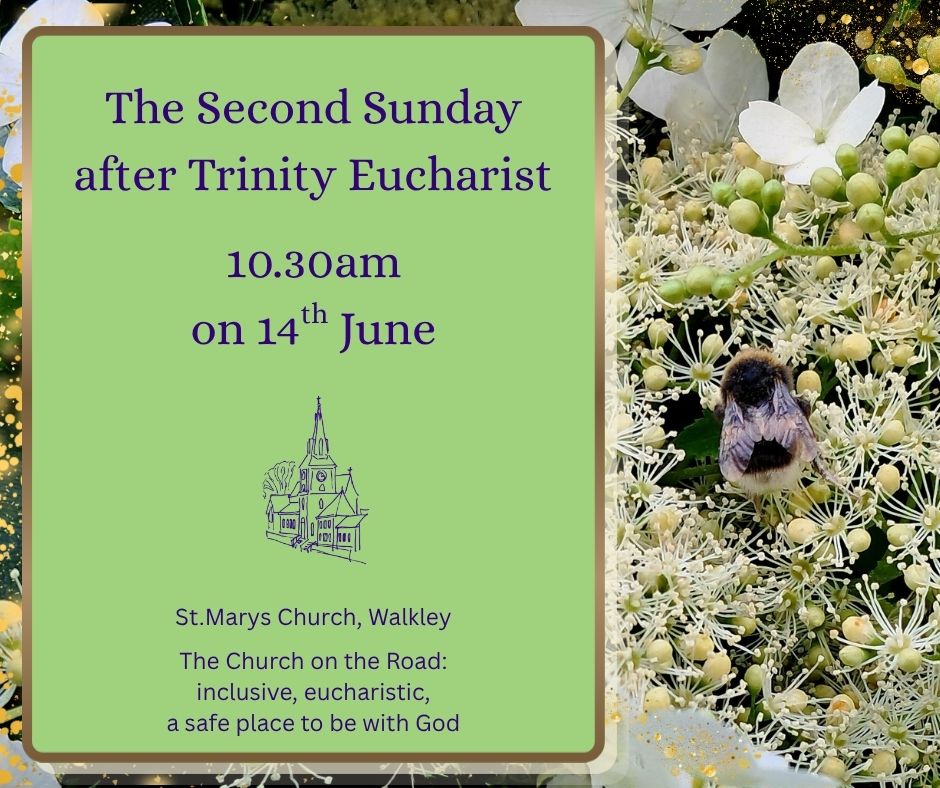
Watch this week's service on YouTube
Download the order of service here: 26 06 14 2nd Sunday after Trinity
Read this week's Church News
The Readings
Romans 5.1-8
Therefore, since we are justified by faith, we have peace with God through our Lord Jesus Christ, through whom we have obtained access to this grace in which we stand; and we boast in our hope of sharing the glory of God. And not only that, but we also boast in our sufferings, knowing that suffering produces endurance, and endurance produces character, and character produces hope, and hope does not disappoint us, because God’s love has been poured into our hearts through the Holy Spirit that has been given to us.
For while we were still weak, at the right time Christ died for the ungodly. Indeed, rarely will anyone die for a righteous person—though perhaps for a good person someone might actually dare to die. But God proves his love for us in that while we still were sinners Christ died for us.
Matthew 9.35-10.8
Then Jesus went about all the cities and villages, teaching in their synagogues, and proclaiming the good news of the kingdom, and curing every disease and every sickness. When he saw the crowds, he had compassion for them, because they were harassed and helpless, like sheep without a shepherd. Then he said to his disciples, ‘The harvest is plentiful, but the labourers are few; therefore ask the Lord of the harvest to send out labourers into his harvest.’
Then Jesus summoned his twelve disciples and gave them authority over unclean spirits, to cast them out, and to cure every disease and every sickness. These are the names of the twelve apostles: first, Simon, also known as Peter, and his brother Andrew; James son of Zebedee, and his brother John; Philip and Bartholomew; Thomas and Matthew the tax-collector; James son of Alphaeus, and Thaddaeus; Simon the Cananaean, and Judas Iscariot, the one who betrayed him.
These twelve Jesus sent out with the following instructions: ‘Go nowhere among the Gentiles, and enter no town of the Samaritans, but go rather to the lost sheep of the house of Israel. As you go, proclaim the good news, “The kingdom of heaven has come near.” Cure the sick, raise the dead, cleanse the lepers, cast out demons. You received without payment; give without payment.
Scripture Quotations are from: New Revised Standard Version Bible: Anglicized Edition, copyright © 1989, 1995 National Council of the Churches of Christ in the United States of America. Used by permission. All rights reserved worldwide. http://nrsvbibles.org
The Sermon
Prepared by The Revd Canon Dr Alan Billings.
My fourteen year old granddaughter was in town on Friday. I was launching
my new book – Policing, Politics and Faith: A Police and Crime
Commissioner’s Diary from Lockdown to 2024. It has a snappy title. There
were drinks and canapes at the St Paul’s Hotel by the town hall and she
played a key part. She rang a bell to get us all to shut up so that speeches
could be made.
For the past few weeks I have been writing a memoir for her about what life
was like when I was a child. In particular, I wanted to recall what it was like if
you became ill before 1948 when the National Health Service came in. She
would be especially interested in this because she owes her very life to the
NHS.
She was born unable to breathe. Her throat kept closing up. She had to have
a tube inserted through the front of her neck into her trachea. She had that in
place from her birth until she was about 3 or 4yrs old. It meant that her
parents had to watch her literally day and night in case she pulled the tube
out or it became dislodged. Without it, she would die.
It also meant she had to be fed through another tube inserted directly into her
stomach and because no air passed over her larynx, her voice box, she
couldn’t make a sound, couldn’t speak, during those early years either.
But had she been born when I had, before the NHS, she would not have
survived. In part because treatment was limited but also because with no
NHS my family, who were working class people, would not have been able to
afford it anyway. My grannie, who was widowed in her forties with three
children, often told me how petrified she was in case one or other of them
became ill. Her dilemma was always this: she could scrape together half a
crown to pay the doctor, but would then have no money left to buy medicines.
Writing the memoir, it’s been hard for me to go even in imagination to those
pre-NHS times, to recall how frightening just the thought of becoming ill could
be for most people.
How much harder then for us to appreciate what a terrifying world ordinary
people lived in at the time of Jesus. There was little or no science-based
medical knowledge and few doctors. So illnesses of every kind – physical,
mental, emotional – were thought to be caused by evil or unclean spirits –
which is really another way of saying: ‘We don’t understand it; it’s beyond our
control.’
And no one with any power or resources would be inclined to have much to
do with poor, sick people. Indeed, it might be best to avoid those afflicted with
evil spirits, the mentally ill, altogether. Not surprisingly, Jesus speaks about
people being harassed and helpless, like sheep without a shepherd.
So when he sends his disciples out into the villages to do what they can for
those with infirmities and sickness, that is as much about restoring some
hope, some dignity for people who could otherwise so easily feel helpless and
ground down. And this, says Jesus, is what it means for God’s kingdom to
come.
And this, it seems to me, is how Jesus sees the gospel – the good news.
We need to hear that again in our own time, because it’s often all too easy to
fall into despair. In the face of wars, injustice, poverty and disease we can feel
that the world is going backwards. As a nation we seem gripped by
something like that in our time, because never in human history has so much
wealth and ingenuity been dedicated to the paltry and trivial purposes of just
a few privileged people.
At moments like this we need to hear that gospel call of Jesus. Alright, so we
are not going to see the great scourges of the world irradicated in our lifetime,
but we can each take some small step to do some good, to lay one brick in
the edifice of a better world to come.
The disciples went out to encourage people. Christ brought his church into
being to do the same. To say to each generation: care deeply about the
things that matter, things that will probably not come to pass in your lifetime.
This is how our quite ordinary lives achieve significance. And then when the
kingdom comes in all its fullness there will be that one small brick in the
foundations with your name on it.
The Prayers
Prepared by Catherine.
We give thanks for the gift of music, for voices to sing with, for instruments to
play. We pray for the church, whose worship is enriched by music of many
different styles and from many different ages. We pray for church musicians,
choirs and music co-ordinators worldwide, from cathedrals to local churches,
including all who contribute to music here at St. Mary’s We give thanks for the
work of the Royal School of Church Music in providing musical resources for
worship.
Jesus, Lord of your Church,
in your mercy, hear us.
We give thanks that music is a language that can cross national and cultural
boundaries, bringing people together from different nations. We celebrate the
many different styles and genres of music throughout the world, and pray for
musicians worldwide. We remember, too, those places where music is
restricted or banned and where it is dangerous to be a musician. And we pray
for places where music has been used as a means of torture or intimidation.
Jesus, Lord of your Church,
in your mercy, hear us.
We give thanks that music is an activity that brings us together as community.
We pray for our local bands, choirs, school groups and other local musicians
and singers. We pray in particular for the many musicians who make use of our
buildings during the week.
Jesus, Lord of your Church,
in your mercy, hear us.
We give thanks that music can help soothe pain and distress. We pray for the
work of music therapists and musicians who visit hospitals and care homes.
And we remember those known to us who are in particular need of healing at
this time.
Jesus, Lord of your Church,
in your mercy, hear us.
We give thanks that music can provide solace during times of grief, and for the
role music plays in funeral and thanksgiving services. We remember those who
have died. We think in particular of the artist David Hockney, and also of
anyone known to us personally whom we see no more.
Jesus, Lord of your Church,
in your mercy, hear us.
Merciful Father,
Accept these prayers
For the sake of your Son
Jesus Christ, our Lord
Amen.
Common Worship: Times and Seasons, material from which is used here is copyright (c) 2010 The Archbishops' Council