

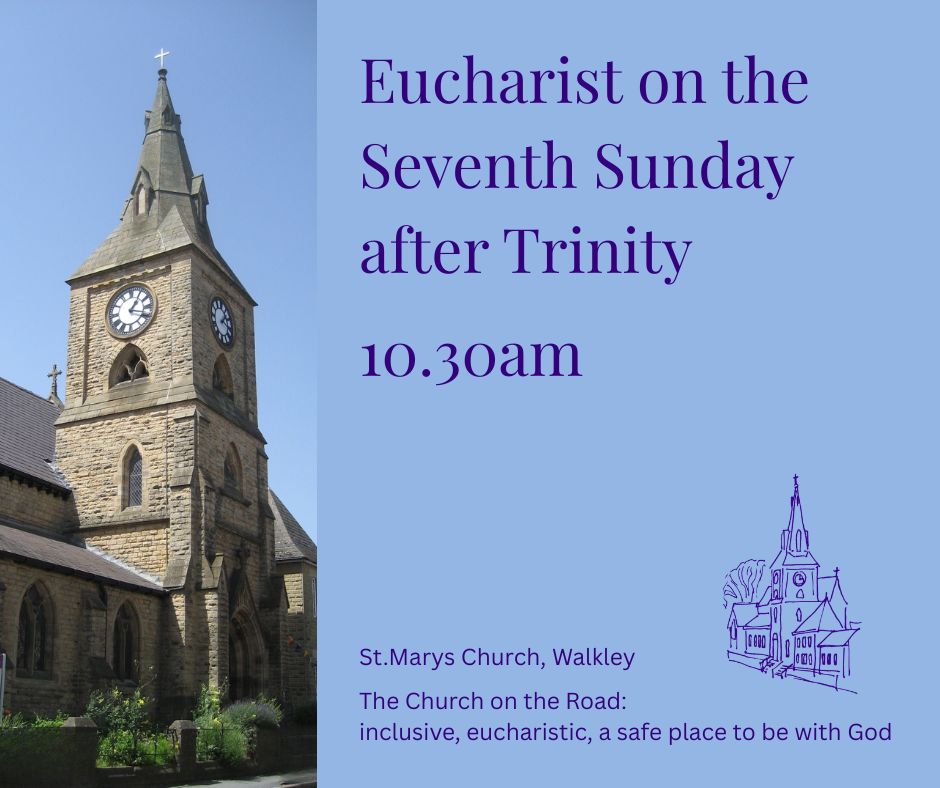
Watch this week's service on YouTube
Download the order of service here: 26 07 19 7th Sunday after Trinity
Read this week's Church News
The Readings
Romans 8.12-25
So then, brothers and sisters, we are debtors, not to the flesh, to live according to the flesh— for if you live according to the flesh, you will die; but if by the Spirit you put to death the deeds of the body, you will live. For all who are led by the Spirit of God are children of God. For you did not receive a spirit of slavery to fall back into fear, but you have received a spirit of adoption. When we cry, ‘Abba! Father!’ it is that very Spirit bearing witness with our spirit that we are children of God, and if children, then heirs, heirs of God and joint heirs with Christ—if, in fact, we suffer with him so that we may also be glorified with him.
I consider that the sufferings of this present time are not worth comparing with the glory about to be revealed to us. For the creation waits with eager longing for the revealing of the children of God; for the creation was subjected to futility, not of its own will but by the will of the one who subjected it, in hope that the creation itself will be set free from its bondage to decay and will obtain the freedom of the glory of the children of God. We know that the whole creation has been groaning in labour pains until now; and not only the creation, but we ourselves, who have the first fruits of the Spirit, groan inwardly while we wait for adoption, the redemption of our bodies. For in hope we were saved. Now hope that is seen is not hope. For who hopes for what is seen? But if we hope for what we do not see, we wait for it with patience.
Matthew 13.24-30, 36-43
He put before them another parable: “The kingdom of heaven may be compared to someone who sowed good seed in his field; but while everybody was asleep, an enemy came and sowed weeds among the wheat, and then went away. So when the plants came up and bore grain, then the weeds appeared as well. And the slaves of the householder came and said to him, ‘Master, did you not sow good seed in your field? Where, then, did these weeds come from?’ He answered, ‘An enemy has done this.’ The slaves said to him, ‘Then do you want us to go and gather them?’ But he replied, ‘No; for in gathering the weeds you would uproot the wheat along with them. Let both of them grow together until the harvest; and at harvest time I will tell the reapers, Collect the weeds first and bind them in bundles to be burned, but gather the wheat into my barn.’”
Then he left the crowds and went into the house. And his disciples approached him, saying, “Explain to us the parable of the weeds of the field.” He answered, “The one who sows the good seed is the Son of Man; the field is the world, and the good seed are the children of the kingdom; the weeds are the children of the evil one, and the enemy who sowed them is the devil; the harvest is the end of the age, and the reapers are angels. Just as the weeds are collected and burned up with fire, so will it be at the end of the age. The Son of Man will send his angels, and they will collect out of his kingdom all causes of sin and all evildoers, and they will throw them into the furnace of fire, where there will be weeping and gnashing of teeth. Then the righteous will shine like the sun in the kingdom of their Father. Let anyone with ears listen!
Scripture Quotations are from: New Revised Standard Version Bible: Anglicized Edition, copyright © 1989, 1995 National Council of the Churches of Christ in the United States of America. Used by permission. All rights reserved worldwide. http://nrsvbibles.org
The Sermon
Prepared by The Revd Canon Dr Alan Billings.
Now that the England football team is out of the world cup, if I want to
depress myself, I have to fall back on our local newspaper, the Star.
Reading the Star you would think that half the population of Sheffield has
either met with some tragic accident while on holiday or are criminals. I
suppose it is a reminder that life does not always run smoothly and some
people are always ready to take criminal advantage of the rest of us.
Jesus seems to be getting at this in the story he tells in today’s gospel.
We look at life rather as a farmer looks at his fields. The farmer sees weeds
growing alongside the wheat. Our lives are similarly a mix of sickness and
health, good and bad. Why is life like this? Jesus does seem to be suggesting
that life not only is, but will, perhaps must, be like this, to the end of time itself,
until the harvest.
I think we can understand what Jesus is getting at if we lay alongside this
parable, this story, another one. Not a parable Jesus told but a parable Jesus
knew. A parable all Jews knew. One we know as well. One of the first in the
Bible, the story of Adam and Eve in the Garden of Eden.
In that story – and remember it is a story, not history – a story that helps us
understand some aspects of our lives now – in that story the man and the
woman look at the garden just as the farmer looks at his field. But unlike the
farmer’s field, there are no weeds in Eden. Life is idyllic – no weeds, no work,
no sickness, no crime. They want for nothing. Save one thing. Freedom.
Independence. Autonomy.
They are not free to make decisions of their own because they live all the
time under the direct gaze of God, who walks about the Garden in the cool of
the day, like a patrolling and over-protective parent.
Their’s is a doll-like existence. If they are to be free, they have to have their
eyes opened to realise that if they are to grow up, make their own decisions
and choices, they have to leave the Garden. They have to go east of Eden,
away from the visible presence of God.
In the story, this can only happen if they eat the forbidden fruit. Doing that
opens their eyes. They become, we are told, like God, knowing good and evil
– which is why the rabbis don’t think of what happens in the Garden as a fall,
as Christian theologians have tended to do. How can becoming like God, be
a fall?
Once their eyes are open, they have the possibility of making up their own
minds, choosing for themselves between good and evil and everything in
between.
But what the Genesis story seeks to bring home, is that choosing freedom is
not easy. We want freedom, independence. We are less sure about the
responsibility and accountability that goes with it. Which is why, in the story,
Adam and Eve have to be tricked into eating the fruit and having their eyes
opened.
But if they are to grow up, they must leave the Garden for a different context
– one that allows for choice. And that is a context that offers the possibility of
evil as well as good, that leaves them open to change and chance, good
fortune and ill luck.
In his parable of the wheat and the weeds, Jesus is making us think about
reality and why things are, and must be as they are, if we are to have
freedom. This is what God, who created all things, intended. But in a world
where many suffer, that cannot be said glibly.
But notice this, notice this: other flowers can blossom here, east of Eden,
which were unknown in the Garden.
When you no longer have God’s visible presence, you must cultivate faith.
When the future is not assured, hope can blossom. When people stumble
and fall, when death presents itself, the flowers of pity and compassion can
grow.
There are no guarantees that life will go well for us. But there are these
resources to help us through its ups and downs: the blessings of faith, hope,
pity and love. They can be ours. But only because we pay the price – weeds
as well as wheat. Until the harvest.
The Prayers
Prepared by Kath, Reader at St Mary's.
God our Father, hear us when we pray to you in faith.
We give you thanks for this day and the many gifts you give to each of us every day of our lives. Help us not to take any of these for granted, especially all the beauty that is in the world. May we take the time to see it and appreciate it with heartfelt gratitude. Help us to take better care of our planet so that future generations may enjoy it too.
Lord in your mercy,
Hear our prayer.
We pray for your church throughout the world, especially for our sisters and brothers in places where they are not yet free to worship openly.
We pray for all the team, both lay & ordained here at St Mary’s who work so committedly on behalf of us all and our community and for those doing the same in our sister churches of St Marks and St John’s. As Christians may we all recognise that we have a ministry, even if it doesn’t have a formal title and ask God to sustain us in our work for him and our fellow people.
Lord in your mercy,
Hear our prayer.
We continue to pray for our very troubled and turbulent world, for all peoples, communities and nations who are going through dark and difficult times. Lord please do not let us hope that we can resolve our differences peacefully and make the world a better, more just and compassionate place for everyone. Especially we ask God to protect those who put themselves in harm’s way for the sake of others.
We pray for our own country as we begin a new chapter in our government. We give thanks for those who have served with sincerity, especially our outgoing prime minister, Kier Starmer and pray for all in positions of leadership and influence that they work together an act with integrity, humility, courage and compassion and a genuine desire to serve for the good of all. We pray that all who are courageous enough to enter public and political service may be able to work free from threats of harm and that we as citizens may play our part in protecting the democracy and freedoms we enjoy.
We pray for all children and people in education and training who have just completed their year of studies, especially the little children who have had their first taste of school. We pray that they and their parents and carers and their teachers will have an enjoyable summer break. We pray for those who will soon be entering a new stage of their education or transitioning to the world of employment.
Lord in your mercy,
Hear our prayer.
We pray for all who are ill or unwell at this time. May they be lovingly supported as they navigate the changes and challenges they face as a result of their illness. We pray also for those who will be alongside them that they too will be supported, cared for and appreciated. We pray for all who are lonely, that they may find the companionship they long.
Much as we enjoy the warmer weather of summer, we pray for all who find the current extreme heat hard to cope with and for those dealing with its effects on our wildlife and countryside.
In a few moments of quiet let us call to mind anyone known to us who is in particular need of our prayers and let us also bring before God our own needs and concerns.
Lord in your mercy,
Hear our prayer.
We remember those who have died, some recently and some long ago. May they rest in peace and may all who mourn and miss them be comforted and find their own peace.
We remember Ann Widdecombe who has died in terrible circumstances. We pray that she is now at peace and that her family and friends will be comforted and cared for in their loss.
Again in a short time of quiet we remember our own loved ones who are no longer with us.
Lord in your mercy,
Hear our prayer.
Merciful Father, accept these prayers for the sake of your Son, our Saviour, Jesus Christ,
Amen
Common Worship: Times and Seasons, material from which is used here is copyright (c) 2010 The Archbishops' Council