

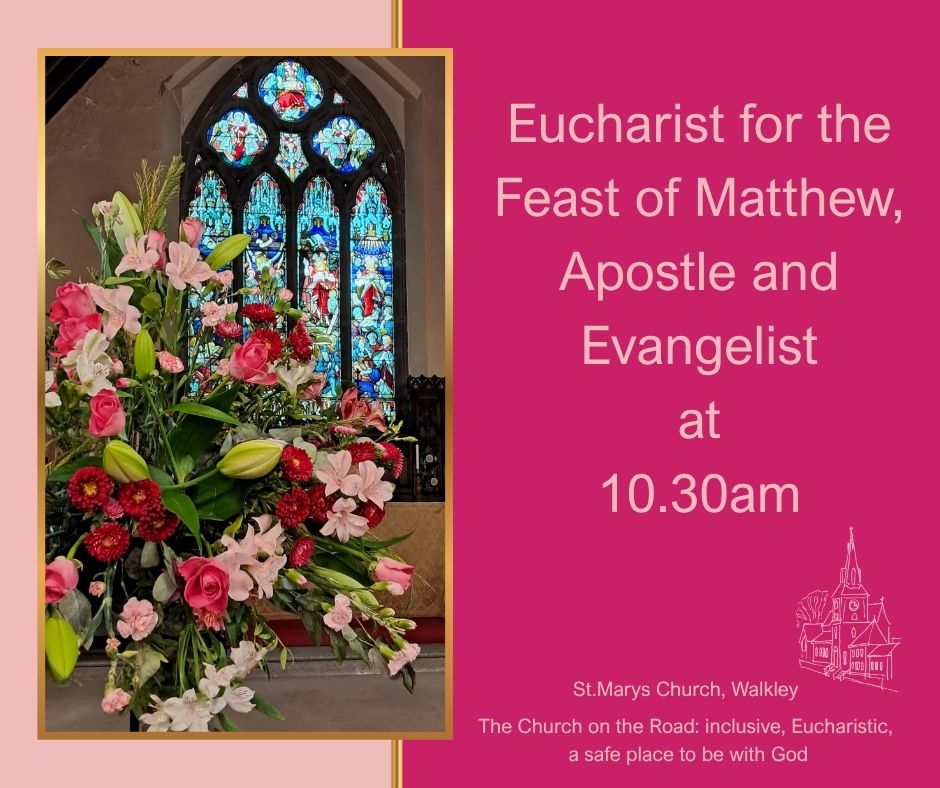
Watch this week's service on YouTube
Download the order of service here: 26 09 20 Matthew
Read this week's Church News
The Readings
2 Corinthians 4.1-6
Therefore, since it is by God’s mercy that we are engaged in this ministry, we do not lose heart. We have renounced the shameful things that one hides; we refuse to practice cunning or to falsify God’s word; but by the open statement of the truth we commend ourselves to the conscience of everyone in the sight of God. And even if our gospel is veiled, it is veiled to those who are perishing. In their case the god of this world has blinded the minds of the unbelievers, to keep them from seeing the light of the gospel of the glory of Christ, who is the image of God. For we do not proclaim ourselves; we proclaim Jesus Christ as Lord and ourselves as your slaves for Jesus’ sake. For it is the God who said, “Let light shine out of darkness,” who has shone in our hearts to give the light of the knowledge of the glory of God in the face of Jesus Christ.
Matthew 9.9-13
As Jesus was walking along, he saw a man called Matthew sitting at the tax booth; and he said to him, ‘Follow me.’ And he got up and followed him.
And as he sat at dinner* in the house, many tax-collectors and sinners came and were sitting* with him and his disciples. When the Pharisees saw this, they said to his disciples, ‘Why does your teacher eat with tax-collectors and sinners?’ But when he heard this, he said, ‘Those who are well have no need of a physician, but those who are sick. Go and learn what this means, “I desire mercy, not sacrifice.” For I have come to call not the righteous but sinners.’
New Revised Standard Version Bible, copyright © 1989 National Council of the Churches of Christ in the United States of America. Used by permission. All rights reserved worldwide. http://nrsvbibles.org
The Sermon
Prepared by Kath, Reader at St Mary's.
Today we are celebrating the feast of St Matthew. If you have been coming to church for any length of time you will, no doubt be familiar with hearing many readings from his Gospel and if you’re fairly new to church, you soon will be familiar with it because it’s one of four gospels that we read from regularly in our services. Coincidentally it happens to be my personal favourite. Perhaps this is because, being one of Jesus’ twelve original disciples, Matthew tells the stories about him so well and there is a great deal of wisdom in there too.
Well we may be familiar with hearing from what Matthew wrote in his gospel but how much do we actually know about who he was and what he did? The Bible doesn’t tell us a great deal so I’ve had to rely on other sources, who are far more knowledgeable than I am, for my research. Hopefully what I’ve discovered will provide some background and context about Matthew’s life and work, and in so doing help us to relate to him more meaningfully.
Perhaps we can start with one of the things we do know and have just heard in our reading, namely that Matthew was a tax collector. He was a Galilean Jew and he worked in Capernaum where Jesus had been staying for a time. In our own times, and indeed throughout much of history, paying tax is not generally popular and I think it’s fair to say that the Inland Revenue probably doesn’t have the biggest fan club, but in Matthew’s time tax collectors, or publicans as they were known, were really hated. So much so that they were excluded from religious worship and shunned in civic life and in business. One of the ways the tax system worked was that the Romans, who were an occupying power, set the rates of tax and the publicans bought the right to collect the taxes. They made their money by charging extra on top of the basic rate and needless to say, some of them were very greedy and corrupt. Some were not above using violence and intimidation to enforce collection of the debts and, if they wanted it, they had the backing of the Romans, who were not exactly known for their subtlety or delicacy in such matters. No wonder the tax collectors were hated. Whatever kind of tax collector Matthew was, when Jesus said “follow me”, he left his booth and followed him.
We can only wonder what Matthew thought as he walked away from the life he had known up to that point and the financial security it had given him. Perhaps he was tired of being hated and grabbed at the chance Jesus was giving him to change. It seems he promptly invited fellow tax collectors to join him as he ate with Jesus and they came. Maybe they could hardly believe that Jesus was choosing to be in their company. When the Pharisees learned that Jesus was mixing with these “sinners” they made it very clear that they didn’t approve. As far as they were concerned these men were social pariahs who were beyond redemption. Rather hypocritical in a way because all complex societies need funds in order to function and taxing is the usual way of getting these funds. Looking down on those who do the dirty work of collecting the money so that others can keep their hands and consciences clean is hardly fair. But then some of the Pharisees didn’t seem to have a problem with fairness or being hypocritical. However, Jesus is quick to put them straight about why he is spending time with these so called “sinners” and how they, the Pharisees, were missing the point.
As one of Jesus twelve disciples, Matthew travelled with him and learned from his teachings. After Jesus death, resurrection and ascension, Matthew originally preached and taught among the Jews in Judea who had converted to Christianity but later he is thought to have taken Christ’s teachings to other countries, possibly as far as modern day Iran. He is venerated in quite a number of churches and faiths, some of whom believe that he was martyred around AD 68.
Given his background it probably won’t surprise you to know that Matthew is the patron saint of accountants, bankers, tax collectors, civil servants and more obscurely of perfumers. Also he is the patron saint of Osorno in Chile and Salerno in Italy where his tomb lies in the cathedral.
It seems Matthew was respected by his fellow disciples who called him Levi. But according to St Jerome he called himself Matthew and he never shied away from being open about his past role as a tax collector. His attitude was if Christ forgave and chose him then there was hope for everyone. I think this is his most powerful personal message throughout the ages and it still holds true for us to us today.
Amen.
The Prayers
Encouraged by our fellowship with all the saints,
let us make our prayers to the Father through our Lord Jesus Christ.
Father, your Son called the saints to leave the past behind them
and to follow him as his disciples in the way of the cross.
Look with mercy upon those whom he calls today, marks with the cross
and makes his disciples within the Church.
Lord, have mercy.
Christ, have mercy.
Your Son told his disciples not to be afraid and at Easter breathed on
them his gift of peace. Look with mercy upon the world into which
he sent them out, and give it that peace for which it longs.
Lord, have mercy.
Christ, have mercy.
Your Son formed around him a company who were no longer
servants but friends, and he called all those who obeyed him his
brother and sister and mother. Look with mercy upon our families
and our friends and upon the communities in which we share.
Lord, have mercy.
Christ, have mercy.
Your Son sent out disciples to preach and heal the sick. Look with
mercy on all those who yearn to hear the good news of salvation,
and renew among your people the gifts of healing.
We pray for Lucy and Paul’s grandson and family.
Lord, have mercy.
Christ, have mercy.
Your Son promised to those who followed him that they would sit
on thrones judging the twelve tribes of Israel and would share the
banquet of the kingdom. According to your promise, look with
mercy on those who have walked with Christ in this life and now
have passed through death.
Lord, have mercy.
Christ, have mercy.
Almighty God,
Grant that your Church
may faithfully hold and make known
the faith that has come to us through the apostles,
that with them and all your saints
we may inherit the glories of eternal life;
through Jesus Christ our Lord.
Merciful Father,
accept these prayers
for the sake of your Son,
our Saviour Jesus Christ.
Amen.
Common Worship: Times and Seasons, material from which is used here is copyright (c) 2010 The Archbishops' Council