

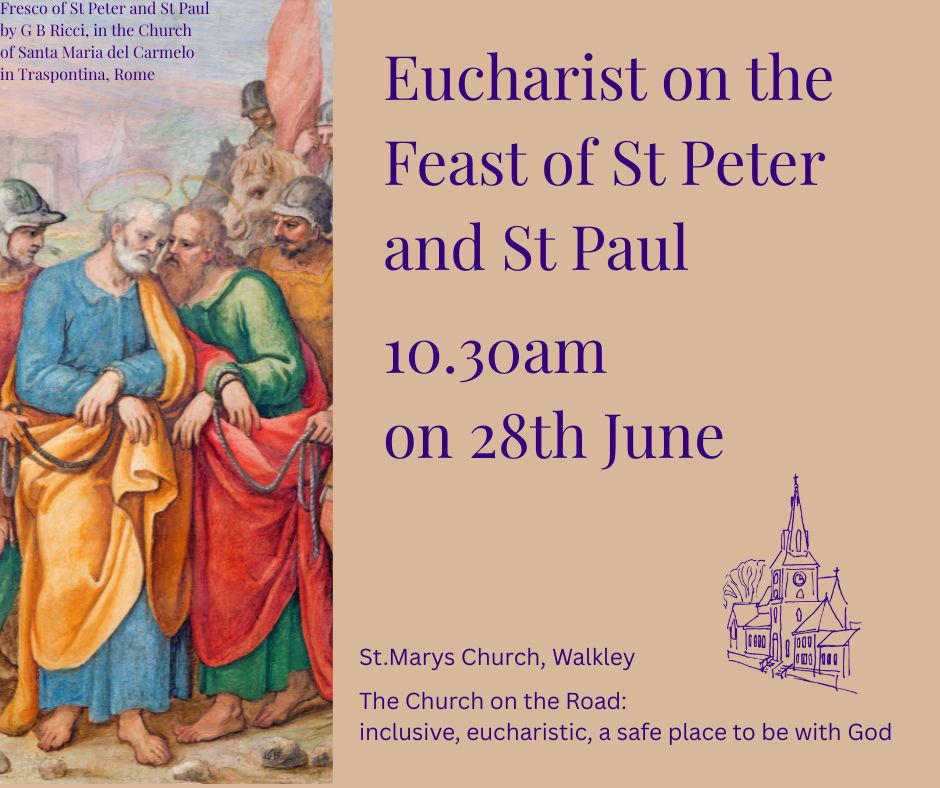
Watch this week's service on YouTube
Download the order of service here: 26 06 28 Peter & Paul Apostles Eucharist
Read this week's Church News
The Readings
Acts 12.1-11
About that time King Herod laid violent hands upon some who belonged to the church. He had James, the brother of John, killed with the sword. After he saw that it pleased the Jews, he proceeded to arrest Peter also. (This was during the festival of Unleavened Bread.) When he had seized him, he put him in prison and handed him over to four squads of soldiers to guard him, intending to bring him out to the people after the Passover. While Peter was kept in prison, the church prayed fervently to God for him.
The very night before Herod was going to bring him out, Peter, bound with two chains, was sleeping between two soldiers, while guards in front of the door were keeping watch over the prison. Suddenly an angel of the Lord appeared and a light shone in the cell. He tapped Peter on the side and woke him, saying, ‘Get up quickly.’ And the chains fell off his wrists. The angel said to him, ‘Fasten your belt and put on your sandals.’ He did so. Then he said to him, ‘Wrap your cloak around you and follow me.’ Peter* went out and followed him; he did not realize that what was happening with the angel’s help was real; he thought he was seeing a vision. After they had passed the first and the second guard, they came before the iron gate leading into the city. It opened for them of its own accord, and they went outside and walked along a lane, when suddenly the angel left him. Then Peter came to himself and said, ‘Now I am sure that the Lord has sent his angel and rescued me from the hands of Herod and from all that the Jewish people were expecting.’
Matthew 16.13-19
Now when Jesus came into the district of Caesarea Philippi, he asked his disciples, ‘Who do people say that the Son of Man is?’ And they said, ‘Some say John the Baptist, but others Elijah, and still others Jeremiah or one of the prophets.’ He said to them, ‘But who do you say that I am?’ Simon Peter answered, ‘You are the Messiah, the Son of the living God.’ And Jesus answered him, ‘Blessed are you, Simon son of Jonah! For flesh and blood has not revealed this to you, but my Father in heaven. And I tell you, you are Peter, and on this rock I will build my church, and the gates of Hades will not prevail against it. I will give you the keys of the kingdom of heaven, and whatever you bind on earth will be bound in heaven, and whatever you loose on earth will be loosed in heaven.’
Scripture Quotations are from: New Revised Standard Version Bible: Anglicized Edition, copyright © 1989, 1995 National Council of the Churches of Christ in the United States of America. Used by permission. All rights reserved worldwide. http://nrsvbibles.org
The Sermon
Prepared by The Revd Canon Dr Alan Billings.
Last week you must have had a heart of stone not to have been moved by
the Prime Minister’s resignation speech.
Alright, so you have a heart of stone. At least for politicians.
But there is something odd about our politics at the moment. I remember how
only a few years ago, we were all saying that what we needed were
politicians who had done something in what we called ‘the real world’ before
becoming politicians. How could MPs understand the realities of day to day
living if they had never had – what we called – a proper job before they
entered parliament.
And yet this week, the public have clamoured for the departure of a politician
who did have a proper job before he became an MP – the Prime Minister was
a barrister and crown prosecutor who only entered parliament at the age of
52 - and instead, now seem to want someone who has been involved in
politics all his working life.
It reminded me of a debate we had within the church some years ago about
whether we should be ordaining young people straight from university or
require them first to have had some other job, some wider experience, before
they became parish priests.
I was a tutor at two theological colleges and saw both. You may know the
names of some of my former students who came more or less directly from
university. Radio 4 listeners will know Giles Fraser and Lucy Winkett, now fine
vicars in London, and we all know Matthew Rhodes, vicar of Ranmoor.
But there were others who came having had another career first. I recall, for
instance, a senior officer in the British Army, serving at that time in Northern
Ireland during the Troubles. When he came for interview he landed in a
helicopter on the college field. It seemed a bit pretentious, but it was for
security reasons.
I asked him why he, a soldier, wanted to be a priest. I thought the two callings
would be so far apart. How wrong I was.
He said that he had many young men under his command, some only
teenagers, many in their early twenties. Yet in Belfast they were going out on
patrol, risking their lives every day to IRA sniper fire. He was like a father to
them. Encouraging them when their spirits were low, celebrating with them
when something good happened. He had the hard task of writing to their
parents or partners if they were injured or, worse, killed. He might have been
a military man; he was also a pastor.
Of course in the first years of the church after the death and resurrection of
Jesus, all the leaders had to earn a living. Today we are giving thanks for two
of them – St Peter and St Paul. Both had jobs but were very different sorts of
people.
Peter was a fisherman and not always the most attractive human being. He
was impulsive, even violent. You’ll remember that in the Garden of
Gethsemane he was armed. He cut off the ear of the servant of the High
Priest with a sword when they came to arrest Jesus. He was, shall we say, a
bit rough and ready. Is this why Jesus calls him Peter – his original name was
Simon - which means a Rock? A rock, after all, might be solid, but it’s rough;
it’s not a polished stone.
But Paul, a tent maker, was polished. He had been a Pharisee. He was
educated. He could write beautifully. Think of that lovely passage about love
in his letter to the Corinthians.
‘Love is patient and kind … it does not rejoice in wrong, but rejoices in the
right. Love bears all things, believes all things, hopes all things, endures all
things. Love never ends … ‘
Did that mean that the church should look for leaders who were equally
educated and polished?
Not at all because what the church looked for then, as now, were other
qualities which are not necessarily dependent on experience or education.
In politics we realised this week that what we had wanted all along was not
necessarily someone with a track record in a previous career, but someone
who could combine competence and an ability to communicate, to tell a story
and connect with us. Time will tell how this plays out.
And in our church leaders, our priests, we look now, as they did in the earliest
days, for those who through preaching, presiding and pastoring make God
findable. Making God findable – that is and always was the priestly vocation.
The Prayers
Encouraged by our fellowship with all the saints,
let us make our prayers to the Father through our Lord Jesus Christ.
Father, your Son called many different people to leave the past behind
them and to follow him as his disciples in the way of the cross. Look
with mercy upon those whom he calls today, marks with the cross
and makes his disciples within the Church.
Lord, have mercy.
Christ, have mercy.
Your Son told his disciples not to be afraid and at Easter breathed on
them his gift of peace. Look with mercy upon the world into which
he sent them out, and give it that peace for which it longs.
Lord, have mercy.
Christ, have mercy.
Your Son formed around him a company who were no longer
servants but friends, and he called all those who obeyed him his
brother and sister and mother. Look with mercy upon our families
and our friends and upon the communities in which we share.
Lord, have mercy.
Christ, have mercy.
Your Son sent out disciples to preach and heal the sick. Look with
mercy on all those who yearn to hear the good news of salvation,
and renew among your people the gifts of healing.
Lord, have mercy.
Christ, have mercy.
Your Son promised to those who followed him that they would sit
on thrones judging the twelve tribes of Israel and would share the
banquet of the kingdom. According to your promise, look with
mercy on those who have walked with Christ in this life and now
have passed through death.
Lord, have mercy.
Christ, have mercy.
Almighty God,
you have built your Church upon the foundation of the apostles and prophets,
with Jesus Christ himself as the chief cornerstone:
so join us together in unity of spirit by their doctrine,
that we may be made a holy temple acceptable to you;
through Jesus Christ our Lord.
Lord, have mercy.
Christ, have mercy.
Merciful Father,
accept these prayers
for the sake of your Son,
our Saviour Jesus Christ.
Amen.
Common Worship: Times and Seasons, material from which is used here is copyright (c) 2010 The Archbishops' Council