

Watch this week's service on YouTube
Download the order of service here - 26 01 18 Second Sunday of Epiphany Eucharist
Read this week's Church News
The Readings.
1 Corinthians 1.18-end
For the message about the cross is foolishness to those who are perishing, but to us who are being saved it is the power of God. For it is written,
‘I will destroy the wisdom of the wise,
and the discernment of the discerning I will thwart.’
Where is the one who is wise? Where is the scribe? Where is the debater of this age? Has not God made foolish the wisdom of the world? For since, in the wisdom of God, the world did not know God through wisdom, God decided, through the foolishness of our proclamation, to save those who believe. For Jews demand signs and Greeks desire wisdom, but we proclaim Christ crucified, a stumbling-block to Jews and foolishness to Gentiles, but to those who are the called, both Jews and Greeks, Christ the power of God and the wisdom of God. For God’s foolishness is wiser than human wisdom, and God’s weakness is stronger than human strength.
Consider your own call, brothers and sisters: not many of you were wise by human standards, not many were powerful, not many were of noble birth. But God chose what is foolish in the world to shame the wise; God chose what is weak in the world to shame the strong; God chose what is low and despised in the world, things that are not, to reduce to nothing things that are, so that no one might boast in the presence of God. He is the source of your life in Christ Jesus, who became for us wisdom from God, and righteousness and sanctification and redemption, in order that, as it is written, ‘Let the one who boasts, boast in the Lord.’
John 2.1-11
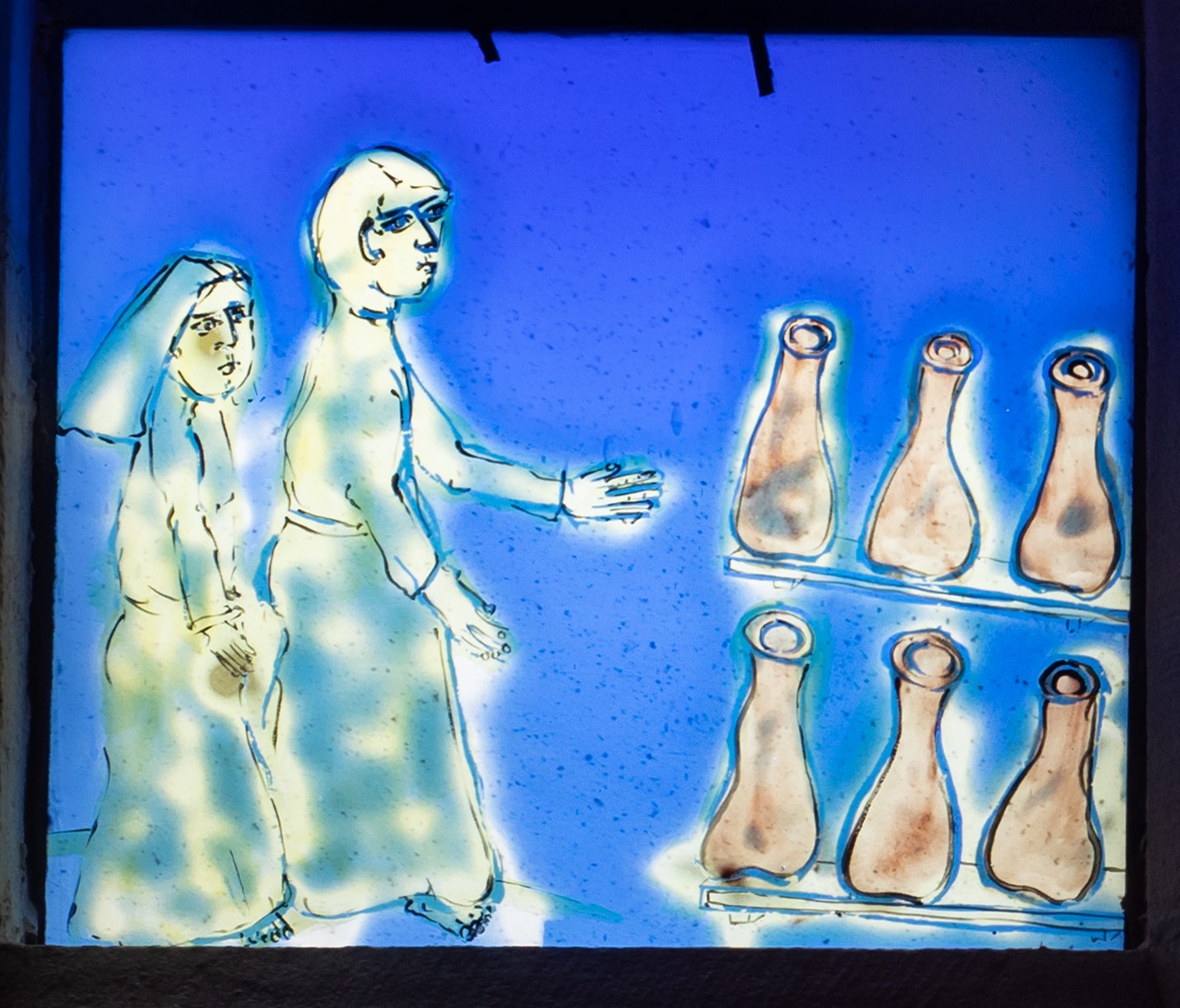
On the third day there was a wedding in Cana of Galilee, and the mother of Jesus was there. Jesus and his disciples had also been invited to the wedding. When the wine gave out, the mother of Jesus said to him, “They have no wine.” And Jesus said to her, “Woman, what concern is that to you and to me? My hour has not yet come.” His mother said to the servants, “Do whatever he tells you.” Now standing there were six stone water jars for the Jewish rites of purification, each holding twenty or thirty gallons. Jesus said to them, “Fill the jars with water.” And they filled them up to the brim. He said to them, “Now draw some out, and take it to the chief steward.” So they took it. When the steward tasted the water that had become wine, and did not know where it came from (though the servants who had drawn the water knew), the steward called the bridegroom and said to him, “Everyone serves the good wine first, and then the inferior wine after the guests have become drunk. But you have kept the good wine until now.” Jesus did this, the first of his signs, in Cana of Galilee, and revealed his glory; and his disciples believed in him.so that you may be blameless on the day of our Lord Jesus Christ. God is faithful; by him you were called into the fellowship of his Son, Jesus Christ our Lord.
The Sermon
Prepared by The Revd Canon Dr Alan Billings.
We’ve just read about Jesus’ first miracle.
And I wondered if you thought there was anything strange about it?
What I mean is this.
When we think about the miracles we think of something amazing, but also
something that is done to meet a need, often a desperate need. A blind man
receives his sight. A woman, plagued by continuous menstrual bleeding, is
cured. Loaves and fishes are multiplied and hungry people are fed.
A miracle is something astonishing, but also something that meets great
need.
But this miracle is not like that.
There’s a wedding reception. They run out of wine. It’s an embarrassment but
hardly a desperate need. Yet Jesus turns water into wine and John records it.
So what is going on?
Some years ago, I went to a conference of theological college tutors in the
Holy Land. We were invited to attend Christmas midnight mass in the Greek
Orthodox Church in Bethlehem.
The service began at 9 o’clock in the evening and carried on for the next four
hours.
Bethlehem is not in modern Israel. No Jews live there now. It’s a Palestinian
town, with an Arab population of Christians and Muslims, but it’s under Israeli
occupation.
When we were there, the Arab population had been holding protests and all
Palestinian towns were under a night time curfew, enforced by the army.
Every night of the year, that is, except this one, Christmas Eve.
So all the Arab Christians had come out, by night, into the church, for these
four precious hours. The church was packed: children, teenagers, mothers
carrying babies, there were grandmothers and grandfathers, some barely
able to walk.
If you have ever been to an Orthodox service you will know that they are long.
Priests disappear for long stretches of time behind a screen at one end called
an iconastasis. There is nowhere to sit; people mill around, chatting and
talking until the priests reappear for the next piece of the action – to give out
blessed bread or light candles, or kiss a crucifix, or chant something in their
rich and deep bass baritone voices.
For those Arab Christians in Bethlehem living under curfew, the four hour
service gave them the chance to catch up on news of friends and neighbours
that they hadn’t seen for a while. It gave teenage boys the chance to chat up
teenage girls – which they were doing in every dark corner.
There was a lot of talk; a lot of laughter; almost a day out atmosphere. And
into this every so often a small procession of priests and nuns would appear;
the gospel would be read; the holy book would be kissed by as many as
could get to it. This is religion Orthodox style – very different from our more
solemn midnight mass.
We tend to make a separation between things that are religious – like this
service – and things that are not. But the Orthodox Christians don’t see it that
way. For them, everything is potentially religious, because religion is
everything that makes human life good and wholesome and worthwhile.
So walking about the church, talking with your neighbour, building up your
friendships, that is religious. For the older girls, chatting with boys,
discovering who is going to make a good life partner, that is religious. For the
old men and women, being greeted and made a fuss of, that is religious. All
these things are religious because they are all about enabling people to
flourish.
And this surely is why the miracle of the water made wine at Cana in Galilee
is recorded in John’s Gospel.
We might find this miracle frivolous. We might not see it as meeting a great
need, only sparing someone’s blushes when the wine runs out. Yet Jesus
turns water into wine, so the party can go on.
We forget that Jesus said: ‘I have come that they might have life.’
Whatever enables us to flourish is true religion. So for us, yes, what we do in
here is important – the prayer and the sacrament put us in touch with God.
But what we do afterwards is just as important – building friendships, forgiving
one another, rejoicing with those who rejoice, weeping with those who weep.
Which is what we do Sunday by Sunday as a congregation over coffee as
much as in the service.
And in the light of this miracle, our vocation is to go from here and understand
what it means in a thousand different situations to turn water into wine.
The Prayers
Prepared by Joe.
Lord of grace and truth, as we gather in your presence, we
remember the words spoken over the early church: that you have
called us, enriched us, and will sustain us to the end. Help us to
hear again the invitation of Jesus: “Come and see.”
Lord, in your mercy: hear our prayer.
We pray for your Church: for integrity in our worship and
welcome; for generosity of spirit when we disagree. We pray for
our archbishops, bishops, and all who serve the Church in St
Mary’s and our sister Churches. Give us, each in our own way, the
grace to say, like John the Baptist, “Look — here is the one who
matters.”
Lord, in your mercy: hear our prayer.
We pray for all nations, especially those gripped by war and civil
unrest. We pray for those with power that they may use it for
peace with wisdom and compassion. We pray for those living with
and dying from the consequences of that power being misused.
May those who lead do so with wisdom, restraint, and
compassion, and speak the truth to all.
Lord, in your mercy: hear our prayer.
We pray for those who may find themselves coming to Christ for
the first time in their lives, and we pray for those returning to Him
after being separated. We welcome these people into the Church
and our hearts and help them in their search for Christ.
Lord, in your mercy: hear our prayer.
We pray for our Walkley, our city of Sheffield, and our country. We
pray for workplaces, schools, and families. We pray that where
relationships are strained, we give patience and the courage to
apologise. Where people feel lonely or overlooked, make us
attentive and kind. Bless those who volunteer, care, teach, heal,
build, serve, and keep things running — often unseen, often tired.
Lord, in your mercy: hear our prayer.
We pray for anyone living with illness of body, mind, or spirit; for
those waiting for test results; for those in pain; for those who
cannot see a way forward. We remember those who are grieving,
especially when grief is private and the world has moved on.
Bring your peace where there is anxiety, your steadiness where
there the urge is to feel overwhelmed, your hope where there is
despair. In a moment of silence, we name before you those on
our hearts…
Lord, in your mercy: hear our prayer.
We commend to your loving care all who have died, trusting your
faithfulness. May they rest in peace and rise in glory. And may
those who mourn find comfort, support, and, in time, gratitude
for shared love. We remember those important to us who we see
no more.
Lord, in your mercy: hear our prayer.
And in a few moments of silence, we bring before you any
concerns or worries that we have in our own lives at this time.
Lord, in your mercy: hear our prayer.
Merciful Father, accept these prayers for the sake of your Son, our
Saviour, Jesus Christ.
Amen.
Common Worship: Times and Seasons, material from which is used here is copyright (c) 2010 The Archbishops' Council