

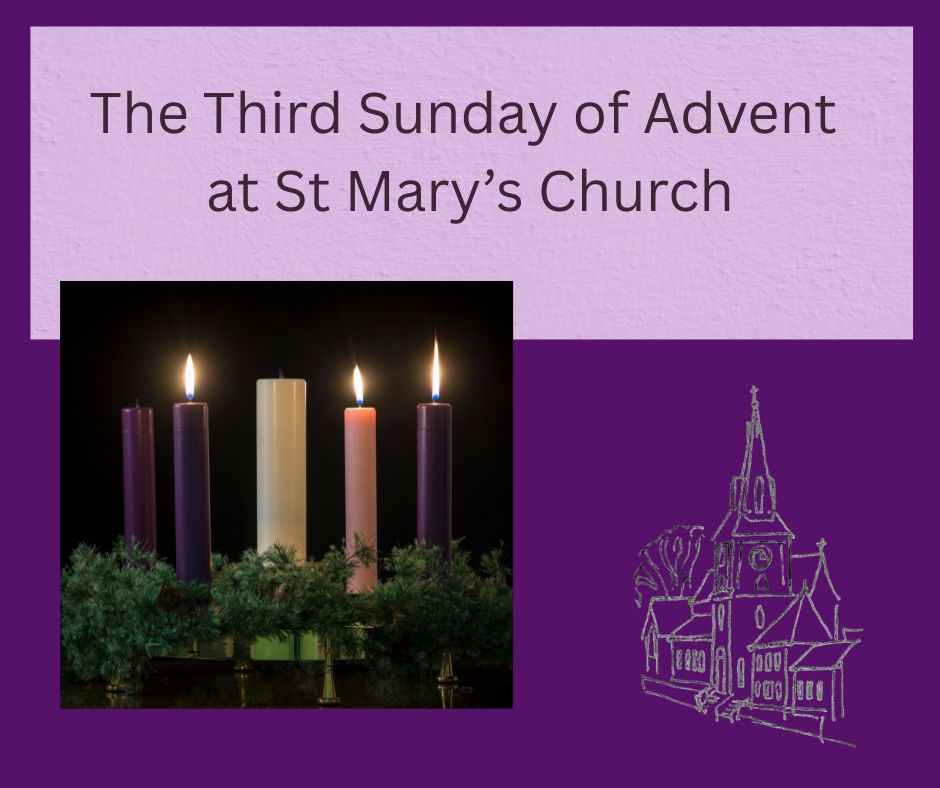
Watch this week's service on YouTube
Download the order of service here - 25 12 14 3rd Sunday of Advent Eucharist
Read this week's Church News
The Readings.
Isaiah 35.1-10
The wilderness and the dry land shall be glad, the desert shall rejoice and blossom; like the crocus it shall blossom abundantly, and rejoice with joy and singing. The glory of Lebanon shall be given to it, the majesty of Carmel and Sharon. They shall see the glory of the Lord, the majesty of our God. Strengthen the weak hands, and make firm the feeble knees. Say to those who are of a fearful heart, “Be strong, do not fear! Here is your God. He will come with vengeance, with terrible recompense. He will come and save you.”
Then the eyes of the blind shall be opened, and the ears of the deaf unstopped; then the lame shall leap like a deer, and the tongue of the speechless sing for joy. For waters shall break forth in the wilderness, and streams in the desert; the burning sand shall become a pool, and the thirsty ground springs of water; the haunt of jackals shall become a swamp, the grass shall become reeds and rushes. A highway shall be there, and it shall be called the Holy Way; the unclean shall not travel on it, but it shall be for God’s people; no traveler, not even fools, shall go astray. No lion shall be there, nor shall any ravenous beast come up on it; they shall not be found there, but the redeemed shall walk there. And the ransomed of the Lord shall return, and come to Zion with singing; everlasting joy shall be upon their heads; they shall obtain joy and gladness, and sorrow and sighing shall flee away.
Matthew 11.2-11
And said unto him, Art thou he that should come, or do we look for another?
Jesus answered and said unto them, Go and shew John again those things which ye do hear and see:
The blind receive their sight, and the lame walk, the lepers are cleansed, and the deaf hear, the dead are raised up, and the poor have the gospel preached to them.
And blessed is he, whosoever shall not be offended in me.
And as they departed, Jesus began to say unto the multitudes concerning John, What went ye out into the wilderness to see? A reed shaken with the wind?
But what went ye out for to see? A man clothed in soft raiment? behold, they that wear soft clothing are in kings’ houses.
But what went ye out for to see? A prophet? yea, I say unto you, and more than a prophet.
For this is he, of whom it is written, Behold, I send my messenger before thy face, which shall prepare thy way before thee.
Verily I say unto you, Among them that are born of women there hath not risen a greater than John the Baptist: notwithstanding he that is least in the kingdom of heaven is greater than he.
The Sermon
Prepared by Joe, Reader at St Mary's.
May I speak in the name of the Father, the Son, and the Holy
Spirit. Amen.
The season of Advent asks us to stand in two places at once.
We’re invited to look back to the first coming of Christ, and at
the same time we look forward to His return. We live our day-
to-day life in the very messy middle bit; a world that can be
weary, confusing and horrifying. It’s a world that can sometimes
feel hopeless.
Today’s readings reflect the tension that exists between those
two viewpoints. Isaiah gives us a picture of God’s new creation
bursting into life. Matthew gives us a picture of a man waiting
for death in prison, wondering if hope has somehow missed
him.
Isaiah speaks to people who feel as though the life has gone
out of them. In scripture, places described as wilderness,
desert, and parched ground are not just geographical
descriptions. They are allegories for the human condition at
those moments when joy, hope and purpose feel far away. A
spiritual desert, so to say.
But Isaiah dares to say that even such places can blossom. He
speaks of feeble hands strengthened, fearful hearts reassured,
and blind eyes opened. He describes a road through the
wilderness that is safe enough for anyone to walk on it. All of
this is the work of God restoring His people.
And then we turn to Matthew and find John the Baptist sitting in
a cell. This is the fellow who we heard referring to the spiritual
leaders of his day as ‘a brood of vipers’ as he preached to
hundreds or even thousands of people in the wilderness. He is
imprisoned and waits in the darkness of his cell, away from the
world, ignorant of what’s happening. He has prepared the way;
but now he sends messengers to ask Jesus, “Are you the one
who is to come, or are we to wait for another?”
Is John losing his faith? No. He is trying to understand why the
Messiah he proclaimed is not doing what he expected. John
was also in a ‘no man’s land’ between the old prophetic
scriptures and the new covenant with Christ. It’s only normal
that he would expect the Messiah to be more like the Old
Testament prophets; after all, he had nothing else to go on. But
John’s world was shifting.
Many of us will know something of that feeling. We do our best
to follow Christ. We try to trust Him, and yet life throws
situations at us that leave us wondering whether the story is
unfolding the way it should. There’s a line in The Simpsons,
uttered by God-fearing Ned Flanders in a moment when he is
questioning why bad things have happened to him "I've done
everything the Bible says, even the stuff that contradicts the
other stuff' Ned has hit that point where blind faith is not
enough; like John, he needs answers.
Jesus doesn’t rebuke John in his reply. Instead, He sends the
messengers back with a gentle but firm reminder. Tell John
what you hear and see. The blind receive their sight, the lame
walk, lepers are cleansed, the deaf hear, the dead are raised,
and good news is proclaimed to the poor.
Jesus is telling John that through Jesus’s actions in the world,
Isaiah’s vision is happening, though perhaps not in the way
John expected. God is still acting, still transforming, still
renewing – but through the human heart and ministry of Christ.
The kingdom might not be coming through thunder, fire and
sword, but through Christ’s actions, the spiritual wilderness is
beginning to bloom.
Many of us, like John, know that a life of faith involves a LOT of
waiting. We wait for clarity, healing, peace, reconciliation, or
simply the strength to manage another day. And in those
waiting places it is easy to feel forgotten by God. Advent
reminds us that God meets us in the waiting, not just in the
fulfilment. Isaiah’s promise does not deny the reality of barren
places; it reminds us that they can also bloom.
Jesus also goes on to speak very warmly about John. John is
no reed shaken by the wind, but a prophet, and more than a
prophet. This is important for us all to hear. John’s struggle
does not diminish his calling; his doubts do not disqualify him.
In fact, Jesus honours him. Faith is not measured by never
asking questions, but by holding steady even when the
answers come slowly or sometimes don’t seem to come at all.
Isaiah’s vision shows a road through the wilderness. It is not a
road out of trouble but a road through it. God does not always
remove the wilderness from our lives. Instead, He provides a
path to walk, companions for the journey, and the strength
needed to continue. We travel through difficult places, and God
is with us.
This is where Isaiah and Matthew meet. Isaiah declares that
God will restore His people. Matthew shows us what restoration
looks like when it arrives in Jesus. Sight returned. Walking
restored. The dead revived. The poor lifted. Grace made
visible. These signs tell us that the kingdom is already breaking
in. But it’s just not yet fully realised.
So – this Advent – what does this mean for us?
We are invited to notice where the signs of God’s kingdom
might already be appearing around us. These signs are not
going to be enormous, written on the sky, epic events. These
signs will be acts of reconciliation and compassion between
people; someone may find hope after despair; someone finds
freedom after a period of addiction. We might see the signs in
our own lives – for example – finding persistence in faith, even
when times are hard. Isaiah reminds us that the faintest bloom
in the desert is still a miracle.
We are called to show the active patience that holds on
because God is faithful. John the Baptist teaches us that even
the greatest servants of God live through seasons of confusion.
Jesus’s response teaches us that God does not scorn such
moments. He answers with reassurance, never contempt.
Third, we are reminded that the work of Christ continues
through us. Advent calls us to be part of the blooming of the
wilderness, gardeners in the desert. How can we do this? By
showing compassion, strengthening in the faint hearted by our
presence, being generous, kind and just. We bring the gifts of
the Holy Spirit to bear on the world around us.
Advent asks us to lift our eyes beyond the moment. The One
John waited for has come. The One we wait for will come
again. And in between those two comings we walk that ‘dark
desert highway’ that Isaiah describes. And we might recognise,
even in the smallest moments, the signs that the deserts are
indeed beginning to bloom.
Amen.
The Prayers
Prepared by Kath.
Common Worship: Times and Seasons, material from which is used here is copyright (c) 2010 The Archbishops' Council